This blog is inspired by my interest in origami, the art of folding paper. I have learned a lot from origami and would like to use this blog as a way to continue learning!
Showing posts with label crease pattern. Show all posts
2012/10/22
Snowflake Crease Pattern
A reader commented on the snowflake I folded last winter and posted about here. I wanted to share how I did it, and so here is the basic crease pattern for it. This one may have more pleats than the one I first folded. I only have the picture to compare the two. Feel free to fold it!
2011/05/03
Creased Images
I wanted to post a link to something interesting.
This is an illustration made from creasing a sheet of paper.
There are plenty more images at Simon Schubert's site.
2011/03/14
Robert Lang Lecture
Gustavus Adolphus College hosted a night with Robert Lang as part of their Rydell Professorship program. It was at the Science Museum of Minnesota where he gave us his standard lecture: From Flapping Birds to Space Telescopes. I've seen it once before, but it was nice to hear it again.
Origami Minnesota also had a presence at the event. We have a neat new flyer, which has been printed on origami sheets!
I think it was a pretty great idea. We also taught some people how to fold cranes for the Cranestorm project, which has reached 70,000+ cranes! They still need almost 30,000 more.
If you want to see Lang's lecture for yourself, it's best to try and catch one of his live lectures, but there is a little bit online. Unfortunately, neither of the following links covers the total content of the lecture. :(
Origami Minnesota also had a presence at the event. We have a neat new flyer, which has been printed on origami sheets!
I think it was a pretty great idea. We also taught some people how to fold cranes for the Cranestorm project, which has reached 70,000+ cranes! They still need almost 30,000 more.
If you want to see Lang's lecture for yourself, it's best to try and catch one of his live lectures, but there is a little bit online. Unfortunately, neither of the following links covers the total content of the lecture. :(
=>The IMA lecture is cut short, because they did not get permission to post all of the lecture.
=>The TED lecture is short because TED limits their speakers to 18 minutes on stage, while Lang's lecture can fill up an hour, easy.
Still, I hope you enjoy it!
2011/02/14
Valentine's Day
| Happy Valentine's Day! |
When I was folding at the library one student was piecing together a box in which he could hold valentine cards at school If it's like when I was in elementary school, then I assume he's going to get a bunch of those little cardboard things with famous cartoon characters saying nice things. And candy.
Anyway, he asked me if I knew how to make a heart shaped box. At the time I did not, but I had felt bad that I could not help him out, so I sat down and figured out how to make one! It took seven prototypes, but number eight looks great. And number nine is slightly smaller so that the two combined make a box and a lid!
I don't know how original my design is. I am sure that others have made a heart box and probably thought much like I did (we folded a different one at Origami MN, actually). I'm proud of it just the same.
Like I said, there were prototypes, one of which I took pictures of as I folded it so that I might remember what I did! I'd like to draw up some diagrams, but it would be the most complicated thing I've diagrammed yet.
| I really like the shape of this. It reminds me of the traditional heart-with-wings model I'm fond of. Or giant fighting robots. |
| This is the first one of the perfect shape. Of course, it's got lines all over it... |
I hope you're having a wonderful Valentine's Day!
2010/07/02
Self-folding Paper!
A video, made by the Harvard Microrobotics Lab, was brought to my attention. It shows a sheet of circuitry that has pre-made creases/hinges build into it and magnets so that once a fold has been made, it will stay in place. The sheet seems to be designed to take advantage of the windmill base that became so popular in Europe. The base is highly versatile, used to make animals, vehicles and toys including the famous Pajarita. You can read more at Make: Online and the Proceedings of the National Academy of Sciences (PNAS) site.This particular sheet is programed to fold into a boat and an airplane, which shows that programed digi-gami is a real possibility in the future.
I have a copy of the article and it is very exciting! It refers to an earlier paper where they discovered a universal crease pattern. I must admit I am in a bit over my head at the moment, so I will leave this post as an introduction to the idea and then write a few posts later when it all makes more sense to me!
The video, for your consideration:
I downloaded the video from the PNAS website.
I do not believe there is any audio, so if you don't hear anything, you're not necessarily deaf.
2010/06/03
Hiden Senbazuru Orikata
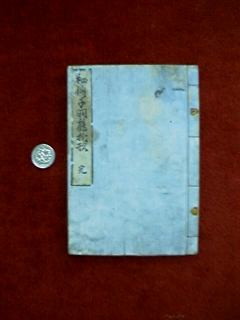
The Hiden Senbazuru Orikata (The Secret of 1000 Cranes Paperfolding) is the first origami text in existence.
It was first published in 1797, and does not appear to have been republished since. It marks a turning point in origami tradition when the method for teaching shifted from exclusively direct instruction to text and diagram instruction. Now, people in one hemisphere teach people in the other hemisphere without ever meeting. There are untold hundreds (or thousands?) of origami books out there, everyone teaching everyone.
This particular book is not the most helpful. If you are a beginner, it lacks many diagrams, and all the models rely exclusively on cutting the paper. Specifically, it shows various ways to precut sheets of paper in order to create connected cranes.
I suggest checking out the full book. There is more to it than origami. It has a few pictures of people playing with cranes, both the animal and the folded paper. I find it very charming. But remember, Japanese is written from the opposite direction, so page 6 is left of page 5, for example.
I would love to be able to read the text, but I do not know how to read Japanese, yet. If anyone thinks they can translate, I would be interested.
[I should mention that the pictures were originally hosted by the Japan Origami Academic Society, but were taken down. The web archive still has the original page up. If it works for you, great, but if it does not, I took the liberty of putting them here.]
2010/03/01
Did you leave room for desert?
Over a year ago I designed a slice of pie, which a friend requested. I folded one immediately, but it was sort of a rough draft. Finally, I have reviewed that original and cleaned it up significantly to create the beautiful model to the left!
It is a fairly simple design. Basically all the paper wraps around the back. The real trick is making it look neat and clean instead of crumpled.
One peculiar design feature I noticed is that it does not follow the M-V=-/+2 rule. I have two vectors where the mountain folds minus the valley folds equals three. Maybe this is because the model is truly three-dimensional and cannot lay flat. If I were to add a valley fold to each vector (and adjust the crease pattern accordingly) then it would lay flat.
Anyway, I am really excited that I finally took the time to tie up this loose end!
[The image is my own, of a slice of pie I designed]
2010/02/10
From Flapping Birds to Space Telescopes
I attended a lecture hosted by the University of Minnesota Institute for Mathematics and its Applications (IMA). The speaker was Robert Lang, renowned origami master.
He talked about the basic principles of origami design from the perspective of crease patterns. He identified four rules:
1) Two-colorability. The open spaces in a pattern can be colored in using two colors and no two adjacent spaces will be the same color.
2) M-V=+/-2 At any given vertex the number of mountain folds will be exactly two more or two less than the number of valley folds.
3) Around each vertex, alternate angles will sum to a straight line.
4) No self intersections of the paper.
For more, watch one of the videos provided by TED or the IMA (for the IMA find the Videos section and click on IMA Math Matters Public Lectures).
He also talked on the modern uses of origami technique and its applications in space, cars, medicine and science. He also answered questions and signed autographs.
I asked him if he thought there was a philosophy of origami. He said that if I asked a hundred folders that question I'd get as many different answers. That every folder has their own philosophy. Lang seems to be a technician at heart. He works out the techniques and the mechanisms so that others can do the art.
The lecture was a chance to expand my origami horizons. Origami Minnesota did some recruiting, so the next meeting might be a bit more energized. I also met Eric Gjerde, author of Origami Tessellations (he is a member of Origami Minnesota, but was not there at my first meeting).
2010/01/29
Crease Pattern Project

I have decided that in order for me to advance as an origami artist, I need a better grasp of how models are designed. My first project will be to take the intermediate level models that I am familiar with, fold them, and as I unfold them I trace the crease pattern. Then I scan them into the computer and print off a hard copy to save in a binder. I currently have fourteen cataloged, and hopefully that will grow!
I am still fairly new to this crease pattern phenomenon, and need some practice getting used to visualizing the final product.
What I have posted here is the pattern for an octopus I designed. It is fairly crude, and I would not be surprised if someone else came up with the same design independently, but it is my first original design and I am proud of it for what it is!
[The image is my own]
2010/01/13
Origami Notebook

One way to record a folded design is to map out all the creases necessary for the final product to emerge. Creases that are a by-product of some other fold, for example a crease that is used only as a reference point for another fold, need not be recorded since they are not folds in the final aspect.
Here I have a scan of a crease pattern that I traced for the traditional crane. There is an awful lot of symmetry for this design. Some patterns have more symmetry than others. An octopus I designed is perfectly symmetrical on four planes while the crane is perfectly symmetrical on only one plane, and nearly symmetrical on the other three. Some patterns are not symmetrical at all.
If I properly mapped out this crane, it should be possible to set all the creases along the traced lines, making the solid lines into mountain folds and the dotted lines into valley folds (or vice versa), then collapse the sheet into a crane in one epic fold!
Here I have a scan of a crease pattern that I traced for the traditional crane. There is an awful lot of symmetry for this design. Some patterns have more symmetry than others. An octopus I designed is perfectly symmetrical on four planes while the crane is perfectly symmetrical on only one plane, and nearly symmetrical on the other three. Some patterns are not symmetrical at all.
If I properly mapped out this crane, it should be possible to set all the creases along the traced lines, making the solid lines into mountain folds and the dotted lines into valley folds (or vice versa), then collapse the sheet into a crane in one epic fold!
[The image is my own, of the traditional crane]
Subscribe to:
Posts (Atom)