Showing posts with label teaching. Show all posts

2010/10/30

Scrap Paper Airplanes

Last week, at the Brookdale Library we hosted an event where we invited 3rd-6th graders to come fold and fly paper airplanes. 

A mass of airplanes that we tested.

We selected six different types of airplanes, trying to find ones that were easy to fold, flew well and were unique in some way. There were six tables, one per plane. Each table had a volunteer that was willing and able to teach the folds. There were also printed instructions so that the students could practice folding them at home. 


The students got to decorate their planes.
In an adjacent empty room, we put tape on the floor so that folders could see how far their creations flew. Some of them went all the way across the room. That's over 30 feet!


We competed for distance.
W also made personalized certificates for all the students that folded four or more different airplanes. I thought this had a nice touch, since it actually reflected what they did. Often, certificates like this overstate a participant's skills, but I honestly think that all the students who got a certificate can fold a paper airplane.
 
It's official, I'm a Paper Airplane Engineer!

All in all, this was an awesome event and was well attended. We had students running around for the whole time we had the tables set up. The testing room had airplanes flying constantly, too.

I think I'll suggest we repeat this event sometime in the future.

2010/07/29

Fiber Arts Festival

On July 24th and 25th I was at the Fiber Arts Festival in West Fargo. When most people think of fiber arts, they think of wool or cotton, which is not entirely wrong. In fact, there is a strong wool contingent at the festival, including shearing sheep, carding the wool, spinning the wool, knitting, crocheting and felting the wool. There were also a variety of other fiber artists there, who taught embroidery, weaving, nålebinding (check it out!), dyeing, quilting and other things.

But what people often forget is that paper is a collection of fibers. Someday, I might be able to do a posting here about how paper is made, but suffice it to say, each sheet is made of untold millions of tiny fiber lengths. In fact, the way to form a crease is to break the fibers in a line (unless you are wet-folding, in which case the moist fiber bends instead of breaking).


At the festival, I spent a lot of time teaching people how to fold a variety of things. One thing I noticed was that a lot of the children had a really solid understanding of space and geometry. I was able to give an instruction once and it would be understood. I suspect it might have something to do with the fact that this craft comes as their third or fourth, not their first. A lot of spacial reasoning is transferable from craft to craft, even if people don't realize it right away. Also, I think that there is a cultural difference between the families in Fargo and the ones in Brooklyn Center, where I teach at the library. I suspect that children in Fargo have more opportunities to learn and are encouraged to do so. It reminds me of an organization called Learning Dreams, where the idea is that if you can get the parents and adults to get excited about learning, then the children will follow the example. I wonder if my teaching origami in the library is one small encouragement for students that seem to be struggling.
Of course, I need to be careful that I do not mix up individuals with statistics. Each student is different.


I realize now that I should have taken a lot of pictures, but simply did not. Maybe I will see about getting photos my friends took and doing a follow up posting.

Before I end, I must give mention to a woman named Caron that I met at the Fiber Arts Festival. She is an artist who is working on a memorial to honor those who have died in our current war. It is titled and still counting. She is making small colorful squares that each represent an American soldier who has died, and on each square is 212 knots or beads to represent all the Iraqi citizens that have died. It is a bit overwhelming to think about the numbers involved. I am glad that she is honoring them in this way.


[The image of paper fibers is from wikipedia; the second image is taken by me, of the models I had on display, most of them traditional designs.]

2010/06/30

Teen Origami Workshop


I drove from the Twin Cities to St. James, Minnesota to teach a group of teenagers how to fold various origami models. I brought various models from home so that the teens could see examples of advanced folding in the modern age. I also did some research so that I could provide a summary of the history of origami and I stressed out about what exactly I was going to teach once I got there.

I was terrified that there would be a dozen or more teens of different skill levels all trying desperately to follow along, but was relieved to see that it was actually a very small group. We folded boxes and cranes, boats and cups. I found them to be good students, who paid attention. 

I was impressed at the selection of origami books available at the Watonwan County Library. It was quite impressive, with a skill range from beginner to advanced. Visitors could legitimately get a broad folding education simply from visiting the library.

All in all, there could have been a slightly larger group, especially since the librarian had thought there would be more, but I would return all over again to repeat the experience.

2010/06/03

Hiden Senbazuru Orikata

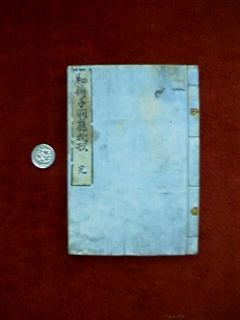
The Hiden Senbazuru Orikata (The Secret of 1000 Cranes Paperfolding) is the first origami text in existence.


It was first published in 1797, and does not appear to have been republished since. It marks a turning point in origami tradition when the method for teaching shifted from exclusively direct instruction to text and diagram instruction. Now, people in one hemisphere teach people in the other hemisphere without ever meeting. There are untold hundreds (or thousands?) of origami books out there, everyone teaching everyone.


This particular book is not the most helpful. If you are a beginner, it lacks many diagrams, and all the models rely exclusively on cutting the paper.  Specifically, it shows various ways to precut sheets of paper in order to create connected cranes. 


I suggest checking out the full book. There is more to it than origami. It has a few pictures of people playing with cranes, both the animal and the folded paper. I find it very charming. But remember, Japanese is written from the opposite direction, so page 6 is left of page 5, for example.


I would love to be able to read the text, but I do not know how to read Japanese, yet. If anyone thinks they can translate, I would be interested.


[I should mention that the pictures were originally hosted by the Japan Origami Academic Society, but were taken down. The web archive still has the original page up. If it works for you, great, but if it does not, I took the liberty of putting them here.]

2010/06/02

The History of Origami

I am going to be teaching a little origami in an introductory course for some middle schoolers. I thought I should provide a handout with a summary of origami history for the students. This is my first draft:

In the year 105 AD, Cai Lun invented paper for the Han Dynasty in China. At that time, it was a very difficult to make paper and so it was only for the very rich. The Chinese may have folded paper shortly after inventing it, but it is not clear if they did. Eventually, monks brought the knowledge of how to make paper from China to Japan in the 6th century.


Nobody knows exactly when the Japanese began folding paper, but is it known that the first models were for ceremonial purposes. The noshi was given with gifts, especially among samurai, and were considered tokens of good luck. The mecho and ocho butterflies were used in traditional Shinto weddings, possibly as early as the Heian period (794–1185). Unfortunately, the models were not written down since they were taught from parents to children. Nor were they given a single name. Origami was also called Orikata, Orisui and Orimono.


Noshi

The first book on origami was published in 1797, called Hiden Senbazuru Orikata (The Secret of One Thousand Cranes Paperfolding) and it gave instructions on how to fold multiple cranes so that they are linked together. All the traditional folds were published in other books and origami became very popular in Japan.

The knowledge of paper making also spread west over the Silk Road through the Middle East. It reached Spain in 1036 with the Moor invasions and spread to the rest of Europe. At first, simple astrological diagrams (similar to fortune tellers) were folded in Spain. In the 16th century, napkin folding became popular among dinner tables for the nobility.

By the time Friedrich Fröbel lived (1782–1852), people all over Europe were folding. He was a teacher who also folded. He changed schools all over the world when he invented kindergarten. As the idea of kindergarten spread, so did origami, but it was still very simple. Miguel Unamuno (1864–1936) was an author and teacher who lived in Spain. He made many discoveries about new ways to fold and his ideas spread to the Spanish speaking countries of the world.

But it would be Japan that would finally make origami a worldwide art. Akira Yoshizawa (1911–2005), grew up folding. It is believed that he folded as many as 50,000 models throughout his life. He was different than other Japanese folders in that he insisted that origami was a creative artform, like painting or sculpting. In the 1950's he became a respected folder and published several books. He invented the standard instructions used by authors today. His work became very popular and he coordinated with many other folders in the United States.

After meeting Yoshizawa, Lillian Oppenheimer founded the Origami Center in New York in 1958 and folding groups started to appear all over the world. Some of the notable groups today include OrigamiUSA, the British Origami Society, Nippon Origami Association, Japanese Origami Art Society, and the Israeli Origami Center.


Further reading:
http://www.britishorigami.info/academic/lister/basichistory.php

[The image is from the
National Diet Library (Diet, as in legislative body)]

2010/05/21

Origametria

I have been thinking a lot about origami combined with teaching mathematics. I applied for a Minnesota Math Corps job and have a minor hope that there will be some way to incorporate origami into their pre-constructed curriculum. This line of thought brought me back to Between the Folds, which is a documentary about origami and shows a spectrum of folders. One folder in particular is Miri Golan.

Miri is the Director of the Israeli Origami Center (the English version of the site seems a bit unpolished) and runs a program called Origametria (this will show you a neat video summarizing the impact of origametria in Jerusalem). The program is the newest generation of programs developed at the IOC in the area of education through origami. The basic set up is to introduce elementary school students to geometry through the use of origami. The idea is that by allowing the students to manipulate the planes on the paper they get a fuller understanding of the angles, shapes and possibilities.

One article I read mentioned Origametria being used in Jewish schools in Los Angeles. I would really like to connect with someone regarding the program and see what can be done in Minnesota.

2010/03/10

Origami at the Library


A couple of weeks ago I got in contact with Jackie, a librarian at Brookdale. She had taught hundreds of children how to fold a crane and then collected them all so that they could be displayed in the library!

We talked about the possibility of teaching more origami and we thought it would be best to try what is called passive programming. Normal programs are ones where a time and date is selected and announced, sometimes requiring registration. Passive programming is where any announcement is make at the time the event is occurring and the participants are people who are already at the library.

Monday, we tried it out! It went well. I still need to get better at gauging a student's skill level and minimizing confusing advice. Slow and simple usually works, but that's not always what is going on in my head. I want to point out the different folds, the math behind them and such. Or sometimes I'll want to jump ahead a step or two. I need to go at the student's pace. But I must have done something right, because everyone successfully made a box and a rabbit!

I will be there again this coming Monday and I'll teach something else to someone else, and it will be good practice for me as a teacher and good publicity for origami as an art form. Maybe I'll see you there!